










Alaska Seeks Interested Buyer to Save 63-Year Old Historic Ferry
Faced with the challenges of a mounting budget shortfall and an aging fleet, the Alaska Marine Highway System, operated by the state’s Department of Transportation, has decided to part with the last of its historic ferries. It issued a Request for Information on March 20 for the Disposition of the m/v Matanuska, but with a catch: it says the priority is to “dispose of the vessel in a manner that honors its historic significance while allowing it to continue serving Alaska in new innovative ways.”
The state is seeking letters of interest from qualified offerors to purchase, acquire, preserve, repurpose the ferry, which was built in Seattle in 1963. It says the focus is on preservation, adaptive reuse, or continued maritime service that respects the vessel’s legacy. It suggests uses for maritime training, tourism, community, or cultural use, education, museum, research, or heritage preservation, but says it will also accept letters proposing scrapping, dismantling, or scuttling.
Named for one of Alaska’s famous glaciers, the ferry was one of three, and the last owned by the state that launched the Alaska Marine Highway System. They were the first ferries built for the state after Alaska gained statehood in 1959. The marine highway provides vital connections for many regions of Alaska that lack long-distance road connections and carries passengers, vehicles, and cargo. The Matanuska spent most of her career running between the area north of Juneau and south to British Columbia.
As the oldest operating vessel of the fleet, she was given a gold-painted funnel and the designation of the “Queen of the Fleet” in her later years. The ships are famous for their medium blue livery, which earned them the popular nickname “blue canoe” in Alaska.
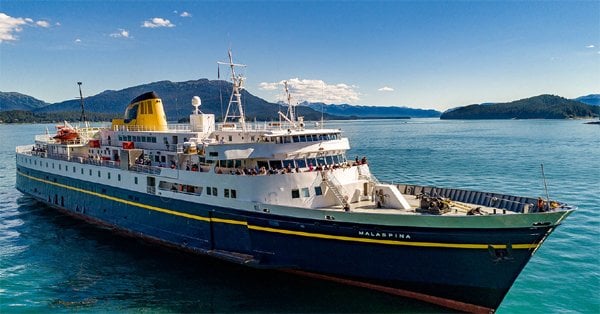
Sister ship Malaspina at the end of her career with the Queen of the Fleet livery (Alaska Marine Highway)
The Matanuska was lengthened in the 1970s to her current size of 408 feet (124 meters) with a capacity for 450 passengers with 106 cabins as well as deck accommodations. And space for approximately 83 vehicles. She featured a lounge, heated solarium, cafeteria, movie area, showers and lockers for deck passengers, and a children’s play area. She is just over 3,000 gross tons with a service speed of 16.5 knots.
Despite the need for vessels on the service – the system has been making do with six ships for the past few years while awaiting replacements – old age caught up with Matanuska, along with years of deferred maintenance. A 2022 survey found extensive steel deterioration and asbestos in the crew quarters. Reports said she would require at least 125,000 pounds of steel replacement. Estimates to restore her for the state’s intercoastal service were at least $45 million or up to $132 million to bring her up to international code for service beyond Alaska.
The Matanuska was docked in Ketchikan, Alaska, and for the past few years has been used to provide accommodations for Alaska Marine Highway staff. Last year, the ferry staff made the recommendation to the state to retire the ship, saying she was simply too costly to restore to service. This year, facing a lack of grant money from the Trump administration, the Alaska Marine Highway System is facing a greater financial shortfall, and the decision was to lower expenses by disposing of the historic ship.

that matters most
Get the latest maritime news delivered to your inbox daily.
Proposals are due to the state by April 14. She follows her sister ships into retirement. The Taku was put up for sale in 2017 with an original price of $1.5 million, but finally sold to a cash buyer from Dubai for $171,000. She was towed to Alang, India, and scrapped. Her sister Malaspina was taken out of service in 2019 when it was determined she too needed steel repairs costing at least $16 million. She was sold in 2022 for $128,250. The buyer had said she would be used as worker housing and a potential maritime museum.
The hope is that the historic ship, which has been a critical part of Alaska’s heritage as a state, can find a suitable new owner and be repurposed for additional service to the community. In January, the state opened bidding for the construction of a new 330-foot ferry for the system that must be built in an American shipyard. Submissions are due by May 28, and they expect the new ferry will be in service by 2029.
Content Original Link:
" target="_blank">