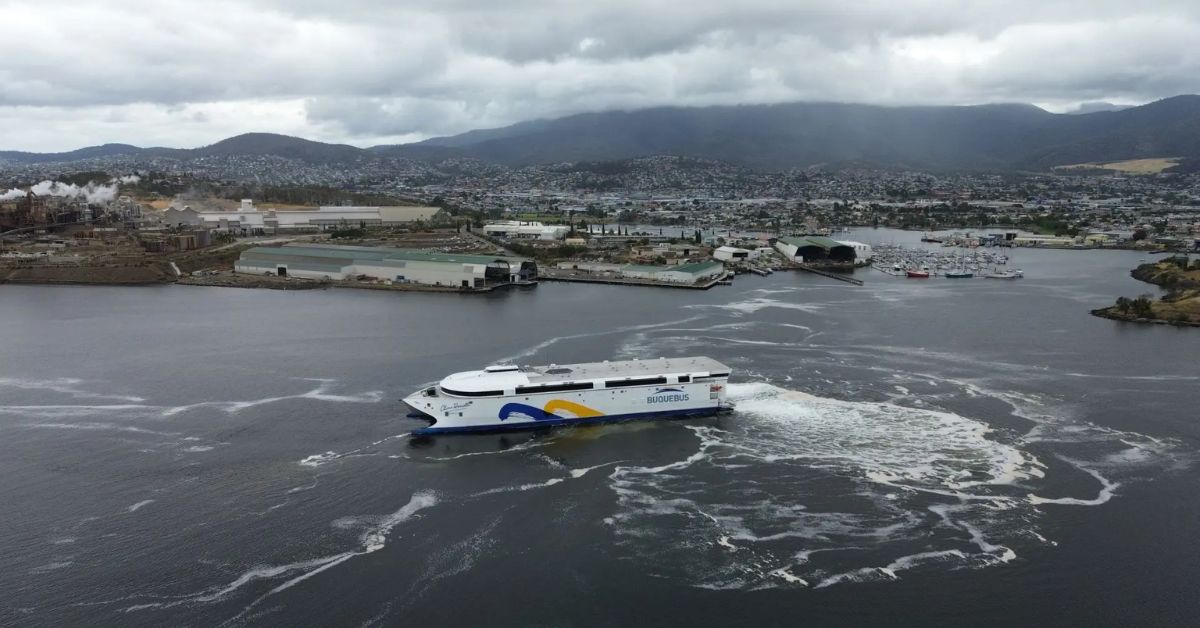
When the aluminium catamaran, Hull 096, entered the waters in Tasmania in 2025, it made history by becoming the world’s largest battery-electric ship.
Named China Zorrilla, after the renowned Uruguayan actress, it is not just a ferry but a 130 m vessel which shows that zero-emissions shipping is now a reality.
The largest battery-electric ship was built by Incat Tasmania for the South American company Buquebus. It will operate on the River Plate between Argentina and Uruguay.
The vessel can accommodate 2100 people and 225 vehicles.
It was not designed to be electric at first; it was reconfigured while it was in the mid-development stage.
Originally, it was to be an LNG vessel, but the design was scrapped, and it was decided to make it entirely reliant on batteries.
China Zorilla’s energy storage system was developed by Wartsila. Its battery capacity is over 40 megawatt-hours, which is four times larger than any maritime battery installation.
The ship has 5,016 lithium-ion battery modules, weighing over 250 tonnes.
This energy is what propels the Zorilla’s 8 electric waterjets, enabling the ferry to